If you are exploring Christianity or looking for a deeper connection to God, you have likely encountered a dizzying number of different churches and denominations. With tens of thousands of Christian groups in the world today, it’s natural to ask a very important, foundational question: Did Jesus Christ intend for His followers to be so divided, or did He establish one specific Church?
When we look at history and Scripture, a fascinating story unfolds. The Catholic Church isn’t just a denomination that appeared hundreds of years after Christ; it is the original Christian family, tracing its roots continuously back to Jesus and His Apostles.
Here is a closer look at the historical and biblical foundations of the Catholic Church.
The Foundation: Jesus and Peter
To understand the origins of the Catholic Church, we have to look at the words of Jesus Himself. In the Gospel of Matthew, Jesus has a pivotal conversation with Simon, one of His closest Apostles.
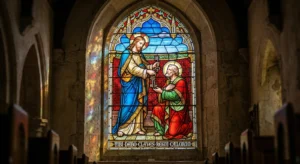
Jesus changes Simon’s name to Peter (which translates to “Rock”) and makes a profound promise:
“And I tell you, you are Peter, and on this rock I will build my church, and the gates of hell shall not prevail against it. I will give you the keys of the kingdom of heaven…” (Matthew 16:18-19)
This moment is foundational. Jesus didn’t just leave behind a book of teachings; He left behind a visible, organized community. By giving Peter the “keys”—a traditional symbol of authority—Jesus established a leader to shepherd His flock after His ascension. Catholics recognize this moment as the establishment of the Papacy, with Peter serving as the very first Pope.
The Unbroken Chain: Apostolic Succession
You might be wondering: What happened after Peter and the original Apostles died? The early Church understood that the mission of Jesus needed to continue until the end of time. To ensure that the truth of the Gospel was preserved and passed down accurately, the Apostles appointed successors. They did this through the laying on of hands, transferring their God-given authority to a new generation of leaders called bishops.
This unbroken chain of leadership is known as Apostolic Succession.
Every Catholic bishop today can trace his spiritual lineage all the way back to the original Twelve Apostles. When you attend a Catholic parish, the priest serving there has been ordained by a bishop who holds this direct, historical connection to the early Church. It’s a profound family tree that has survived empires, wars, and centuries of change.
The Witness of the Early Church Fathers
One of the most compelling pieces of evidence for the roots of the Catholic Church comes from the “Early Church Fathers.” These were the Christian leaders and writers who lived in the first few centuries after Christ—some of whom were personally taught by the Apostles themselves.
When we read their letters and writings, the Church they describe looks remarkably Catholic.
- Ignatius of Antioch (writing around 110 AD) was the first to use the term “Catholic Church,” which means universal. He also strongly defended the real presence of Jesus in the Eucharist and the authority of the bishops.
- Irenaeus of Lyon (writing around 180 AD) argued that the only way to protect against false teachings was to follow the churches founded by the Apostles, specifically pointing to the Church in Rome (the seat of Peter) as the ultimate standard of truth.
The early Christians didn’t believe in a “me and my Bible” approach to faith. They believed in a unified, visible Church that celebrated the sacraments, honored the authority of the bishops, and held fast to the traditions handed down to them.
A Church Built to Last
In the Nicene Creed, a statement of belief written in the 4th century, the Church is described with four specific marks: One, Holy, Catholic, and Apostolic.
- One: United in belief, worship, and leadership.
- Holy: Set apart by God, offering the sacraments as instruments of grace.
- Catholic: Universal, open to all people in all places and times.
- Apostolic: Rooted directly in the teachings and authority of the Apostles.
For over 2,000 years, the Catholic Church has weathered every storm imaginable. It has built hospitals, established universities, preserved the Bible, and produced countless saints. It is entirely unique in human history.
Your Invitation to Explore
Discovering the historical roots of the Catholic Church is often a turning point for many spiritual seekers. It offers the profound comfort of knowing you are part of the original, global family established by Christ Himself.
If you are curious to learn more, you don’t have to figure it all out overnight. The Order of Christian Initiation for Adults (OCIA) is a welcoming, pressure-free process designed specifically for asking questions and exploring the faith.
Are you ready to learn more? Reach out to your local parish today or explore our inquiry resources to take the first step on your journey.